
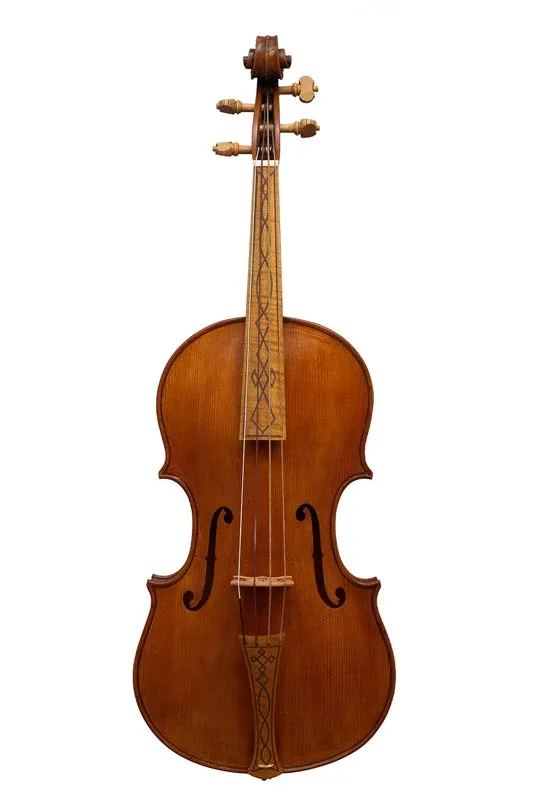

The prototype instrument is housed at the Ashmolean Museum in Oxford under inventory number 12; with the exception of the bridge, all parts of the instrument are original.
In terms of construction and tone, Brescian instruments differ greatly from those of the Cremonese school. The necks were not nailed in from the inside, as is customary there, but instead extend into the body, with the side panels glued in from the sides. The arching, which is crucial to the tone, is convex after a short, deep groove and is very full.
A striking feature of this instrument is its short scale length, which suggests that it was tuned to an alto tuning of C–G–D’–A’. A common tenor tuning such as G–D–A–E’ would have been virtually impossible with a playing length of 38.2 mm and unwound strings. For this reason, the replica is constructed with two separate bridges. It is then possible to set up the instrument for alto tuning with a High Baroque bridge and wound C and G strings, or to set it up for the aforementioned tenor tuning with a lower-set Early Baroque bridge. The instrument then has a vibrating string length of 39.7 cm. With this scale length, the use of the fourth finger is just barely possible. For this setup, however, the use of an unwound D string and a double-wound G string is recommended.